
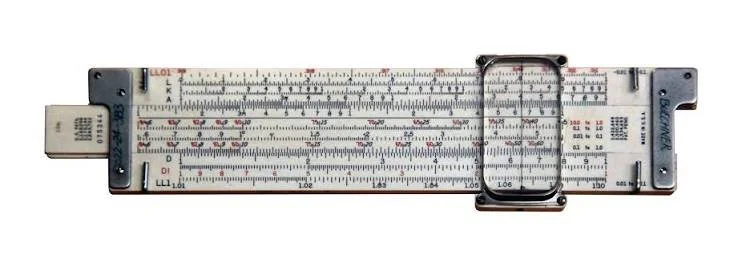
If you don’t know what this object is, it’s a slide rule. And if you don’t know what a slide rule is, that means we’re making progress!
I was taught to use a slide rule in the 1970’s at Levi Fry Junior High School, --- not middle school ---- but junior high. We didn’t even have the middle school concept yet. (Our mascot was the Dragons. We had another junior high in town; its mascot was the Demons. We were Dragons and Demons. Sort of dark, huh? We must have some seriously messed up people in that town…) But back to my point, we used slide rules to solve math problems before electronic calculators were invented. Think of the slide rule as a wooden calculator. It was complicated, simple, and brilliant.
But it wasn’t as fast or as good an early Texas Instruments calculator. Yet, when students started using electronic calculators in schools, traditionalists screamed, “But what are they gonna do when that battery dies? I bet you’ll wish you had taught them to use a slide rule then, won’t you!” It was said nastily as an indictment by people locked in the present who made no effort to see the future.
Then the internet happened, and the same types of people (but a different generation) screamed, “But what are they gonna do when the internet doesn’t work? I bet you’ll wish you had taught them more about how to use books in the library, won’t you!”
Then laptops happened, and the same types of people (but a different generation) screamed, “But what are they gonna do when the battery dies? I bet you’ll wish you had taught them to take more notes by hand, won’t you!”
Now AI is happening, and the same types of people (but a different generation) are screaming, “But what are they gonna do when the AI doesn’t work? I bet you’ll wish you had taught them to work without AI, won’t you!”
My answer then and today: No, No, No, and No. Technology is progress. Technology is shortcuts. Technology is the future. The book I’m writing now (with Sami Scarpitti) for my publisher is titled Storms of the Soul (SOS!): Leading Human Teams in an AI World. I’m spending hours each day researching, writing, editing, and then writing some more about how we need to balance humanity with AI. And I’m using AI constantly, not to write for me, but to find articles and give me their main points so I can decide if I want to read the article with my own eyes and cite it the old fashioned way. I’m using AI ethically --- and as a Baby Boomer I have FULLY embraced it with its startling potential.
I know, I know. Some people are going to say, “Yeah, but these are kids. They don’t do that! They cheat!” And I agree on that point. Students sometimes take too many shortcuts with AI, but let’s be prudent here, okay?
We have to decide the proper age for K-12 students to begin to use generative AI.
We can’t have them use AI for everything.
Screen time is a thing, so let’s NOT have them glued to screens all the time.
Let’s teach them to use AI ethically and kindly.
Let’s turn it around and ask, “What’s going to happen if we DON’T teach our students to use AI correctly?” Here are two research points from the World Economic Forum (WEF)[i], a global leader in spotting job trends, to keep in mind for the future.
The top skills needed to thrive today and in the future require being analytical, resilient, flexible, agile, creative, and motivated.
AI skills are expected to rapidly grow in importance as AI transforms many fields.
It means if we don’t teach our students to think and to use AI effectively and ethically, they’ll be behind the graduates in the world who HAVE been taught to do these things. We’ve reached a pivot point in education: Our students need reading, writing, and math skills so they can use AI more effectively --- NOT just to pass their state assessments. People must be able to read and analyze the AI response to see if it fits what they want to say. They must be able to edit and rewrite the AI response to better fit their intended message. They must know enough math to see if the AI response is giving them the right answer.
Let’s work all of these skills into our new school year, and let’s decide how our students WILL use AI --- not IF they will use AI. Our graduates will thank us as they live and work in the 2070’s, 2080’s, and beyond…
[i] “The Future of Jobs Report 2025.” World Economic Forum. Accessed August 16, 2026. https://www.weforum.org/publications/the-future-of-jobs-report-2025/in-full/conclusions-721d3cd435/#conclusions-721d3cd435.
